
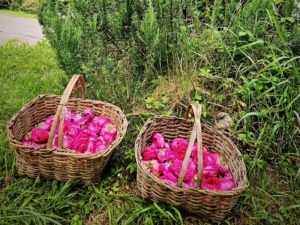
The ancient rose of the Scrivia Valley—the secret flavor of an ancient flower—arrives at Erba Gatta.
We’d been thinking about it for a while. I’d been following the work of Paola and Marco—a couple of friends who are producers—from afar on their social media channels, and my desire to actually try this flavor and bring it into the kitchen at Erba Gatta kept growing. It, too, came from our beautiful Liguria, from the Scrivia Valley—a place few people know about and that deserves to be talked about more—and that alone was enough to pique my curiosity.
Just a few days ago, I found myself thanking Carlo Petrini in a post. Because it’s thanks to him—and to the entire movement he’s built—that we chefs have stepped out of our kitchens. Not to appear on television, not to chase the spotlight, but to do something much simpler and much more important: to seek out, get to know, and shake hands with the great artisan producers of our peninsula. To get closer to those who grow, harvest, and process what eventually ends up on our menus.
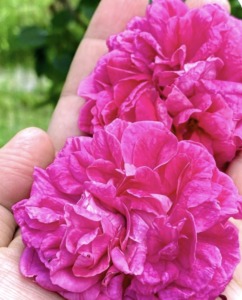
Knowing who is behind each ingredient, and the effort and love that goes into bringing it to our table. It’s a shift in perspective that has put people—and the earth—back at the center of everything.
And it is in this tradition that the rose of the Scrivia Valley finds its place. Because in those parts, the rose is not just an ornamental flower—one that’s simply beautiful to look at. Here, it’s something different. It’s a flower with a purpose, used in preserves, syrups, and even in cooking. A variety of rose that has flourished in the gardens, vegetable patches, and monasteries of the valley, cultivated for centuries primarily by women—first for its medicinal properties and later for the pleasure of its flavor. It’s no coincidence that its syrup is now a Slow Food Presidium—one of those little treasures that were in danger of disappearing and that someone was determined enough to save.
Their company is called Rosa Prìstina, a name that immediately caught my attention. In Latin, “Prìstina” means ancient, primordial—that which comes from the very beginning. It is the rose of days gone by, the one that lives on in the name, and it tells, all on its own, a whole story of rediscovery and memory.
That’s exactly what convinced me to use Paola and Marco’s products. It’s craftsmanship in the fullest sense of the word—complex, involving many hours of work and produced in small batches—because heirloom roses don’t reproduce easily, and every petal must be harvested and processed with care. The company cultivates these heirloom varieties in the rose gardens of Busalla and Ronco Scrivia without using chemical fertilizers or fungicides, because the petal itself is the foundation of everything, and for this reason it must remain pure, natural, and authentic.
Behind a small jar, behind a drop of syrup, lies all the passion of those who devote their time and energy to this variety—a way of life rather than just a job. And it is that same passion that I seek in my ingredients, which are rooted in the local area and in the people who keep it alive.
That’s why I decided to bring the heirloom rose from the Scrivia Valley to Erba Gatta. I envisioned it in a dessert that would highlight its fragrance without overpowering it.
“Because a product like this tells a story,” he says. And telling stories over a meal is what we love to do most.

